Hydro Summary
Hydro Power World Capacity
Hydro Power World Production
Hydro Power World Potential
Additional Content for this chapter is available to our members. Login or Subscribe to view this content.
Hydro Summary
Hydro Summary
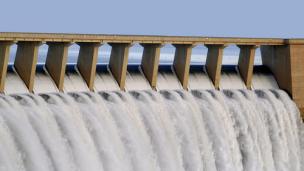
Conventional hydropower is a large scale, dispatchable, baseload, renewable power resource. It is a mature technology, representing ~14% of global energy production in 2024.
- Conventional hydropower is a mature technology, which may be used as base load power, grid support and in some cases energy storage.
- Hydropower depends on adequate rainfall within the impoundment (dam) catchment area. In areas where rainfall is highly variable, increased storage capacity may be utilized - at extra capital expense.
- Hydropower plants have two basic configurations; dams with large reservoirs and run-of-river schemes which shallow reservoirs.
- New projects may be controversial, potentially restricting water availability, inundate sensitive habitat or involve the relocation of people.
- Pumped Hydro Energy Storage is a type of hydro project that allows energy to be stored and used when the demand is high.
Hydro Summary
Hydro Power World Capacity
There is 1,300 GW of installed hydro capacity globally.
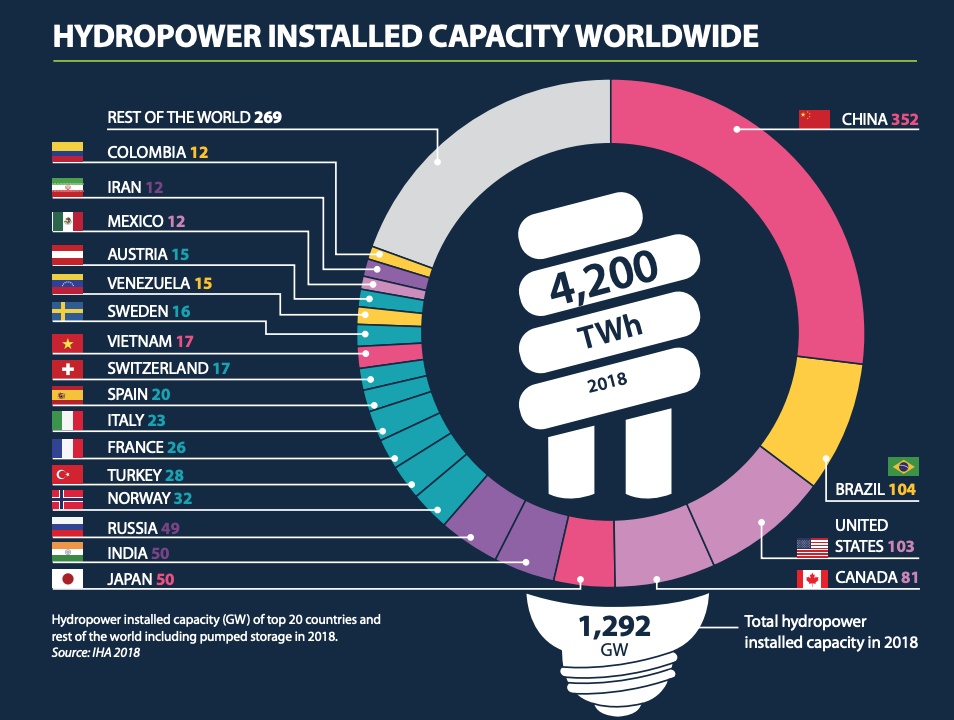
- An estimated 21.8 gigawatts (GW) of hydropower capacity was put into operation last year, including nearly 2 GW of pumped storage, bringing the world’s total installed capacity to 1,292 gigawatts (GW).
- Forty-eight countries added hydropower capacity in 2018. The countries with the highest individual increases in installed capacity were China (8.5 GW) and Brazil (3.7 GW). Among the top five were Pakistan (2.5 GW), Turkey (1.1 GW) and Angola (0.7 GW).
Image source: https://www.hydropower.org/statusreport (accessed June 2021)
Hydro Summary
Hydro Power World Production
In 2018, 4,200 TWh of electricity was produced from Hydropower.
- Between 1974 and 2017, world gross electricity production (including pumped hydro) increased from 6 298 TWh to 25 721 TWh, an average annual growth rate of 3.3%.
- In 2018, electricity generation from hydropower reached an estimated 4,200 terawatt hours (TWh), setting the highest ever contribution from a renewable energy source.
Image source: https://www.hydropower.org/statusreport (accessed June 2021)
Hydro Summary
Hydro Power World Potential
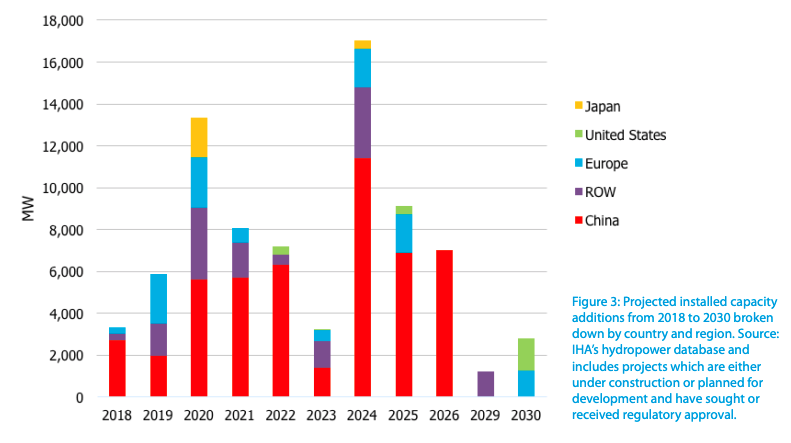
Hydropower has the potential for large growth.
-
Pumped hydropower storage (PHS) has proven to be an essential component for modern and future clean energy systems. The significant increase in variable renewable electricity sources like wind and solar coupled with their displacement of conventional generators has put increasing pressure on power grids and underlined the need for pumped hydropower ‘water batteries’. PHS succeeds in balancing the variable nature of wind and solar by providing reliable energy in bulk and on demand for sustained periods, while also avoiding the need for their curtailment during periods of excess supply, which further supports their increased deployment.
- Pumped hydropower storage (PHS), the world’s ‘water battery’, accounts for over 94 per cent of installed global energy storage capacity and retains several advantages such as lifetime cost, levels of sustainability and scale. The existing 161,000 megawatts (MW) of pumped storage capacity supports power grid stability, reducing overall system costs and sector emissions.
Image source: https://www.hydropower.org/publications/the-world-e2-80-99s-water-battery-pumped-hydropower-storage-and-the-clean-energy-transition (accessed June 2021)